The ultimate way to protect digital privacy
hister.org/posts
Keep useful pages close, searchable, and under your control...
Hister turns the pages you visit and the files you keep into a private, full content search index that you control.
Free software on GitHub Hister
The ultimate way to protect digital privacy
hister.org/posts
Keep useful pages close, searchable, and under your control...
privacy-notes.md
~/documents/notes
A private index makes the things you already found useful again.
AGPLv3
Run it on your own machine or server
No telemetry, no external requests
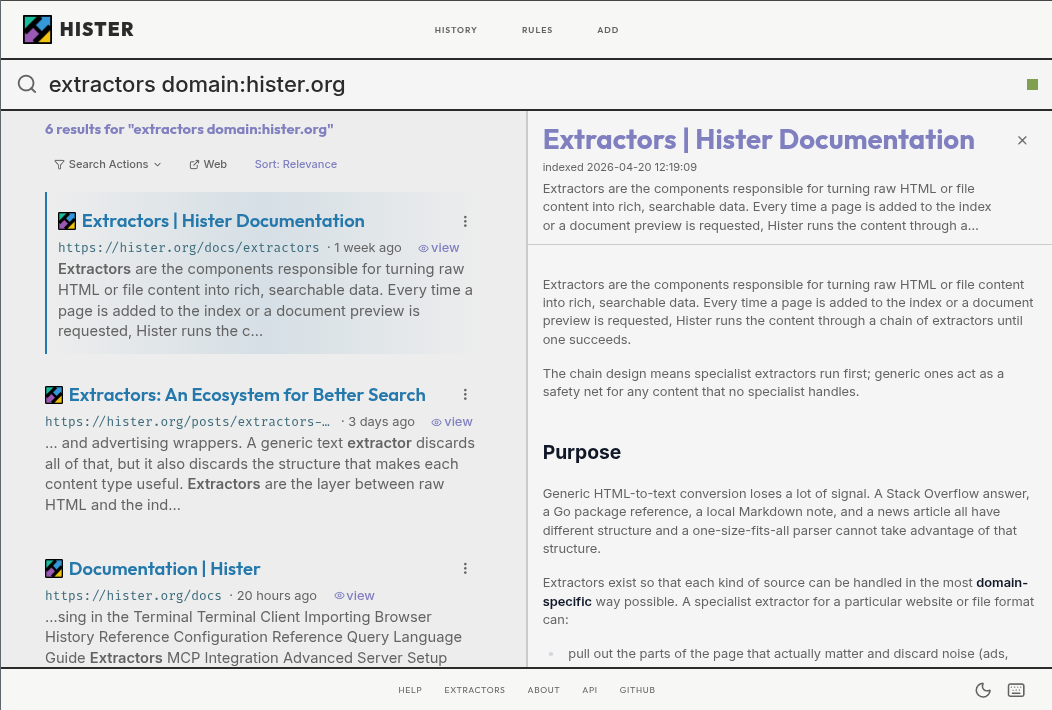
Hister stores extracted document content with the search index and displays it as a readable preview alongside search results.
Look beyond bookmarks and filenames. Hister indexes the full content of the pages and files you choose, then keeps that searchable knowledge on a server you control.
Look beyond titles and URLs to the words inside every indexed document.
Use fields, phrases, wildcards, negation, priorities, and your own aliases.
Open a clean stored preview beside the results without losing your search.
How Hister works
Collect
Save newly visited pages with the browser extension, watch local folders, import your history, or crawl a site.
Index
Hister extracts the parts that matter and indexes their full text on the server you choose.
Find
Search from the web, terminal, command line, or let an AI assistant retrieve it through MCP.
Browser extensions can index pages as they are visited. File watchers, history imports, and crawlers add other sources to the same index.
The index, stored page content, and rules remain on the Hister server you configure. The server has no telemetry and does not require a cloud service.
Read the privacy modelThe server does not phone home or report what you search.
A complete personal setup can run on one local machine.
Clients send indexed content only to the Hister server you configure.
The source is public and licensed as free software under AGPLv3.
Pages, files, and history you choose
Extraction, rules, and searchable index
Results, previews, and integrations
Optional semantic search sends text to the embeddings endpoint you configure. Browser extensions may retrieve page favicons. You choose whether and where these connections run.
Built for real recall
Hister indexes visited pages, watched files, imported browser history, and crawled websites. The index is available through web, terminal, CLI, HTTP API, and MCP interfaces.
Browser extensions can index visited pages automatically. File watching, history imports, and the crawler add other sources.
Full text search supports field filters, quoted phrases, wildcards, negation, date ranges, and query aliases.
Content extractors handle structured data from supported formats and websites. Semantic search is optional.
Skip and priority rules control indexing and ranking. Versioning can retain earlier document content.
The same index is available through the web interface, terminal client, CLI, HTTP API, and MCP server.
A single binary can run locally. Shared servers support user scoped access with SQLite or PostgreSQL.
Hister also supports multiple crawler backends, language specific indexes, content versioning, ownership rules, and configurable extractors.